Results: of product(s) -
Sign in
Wishlist
Cart
OUR CATALOGUE
Our Experts
Best Sellers
New Arrivals
Promotions
Sports clothing
Dragon Ball
Hello,
4.9/5
Excellent
Categories
Sport Nutrition
Health & wellness
Catalogs
My account
My account
My orders
Addresses
Personal data
Contact
Contact
att.clientes@indiex.es
644526451
Calle Segura 43, 28840, Madrid, España
Protein View all
Men's top View all
Men bottoms View all
 Maximum quality with patented formulas
 24/48-hour delivery
 100% secure payments
 Expert advice
LIFE PRO NUTRITION · VITAMINS AND MINERALS
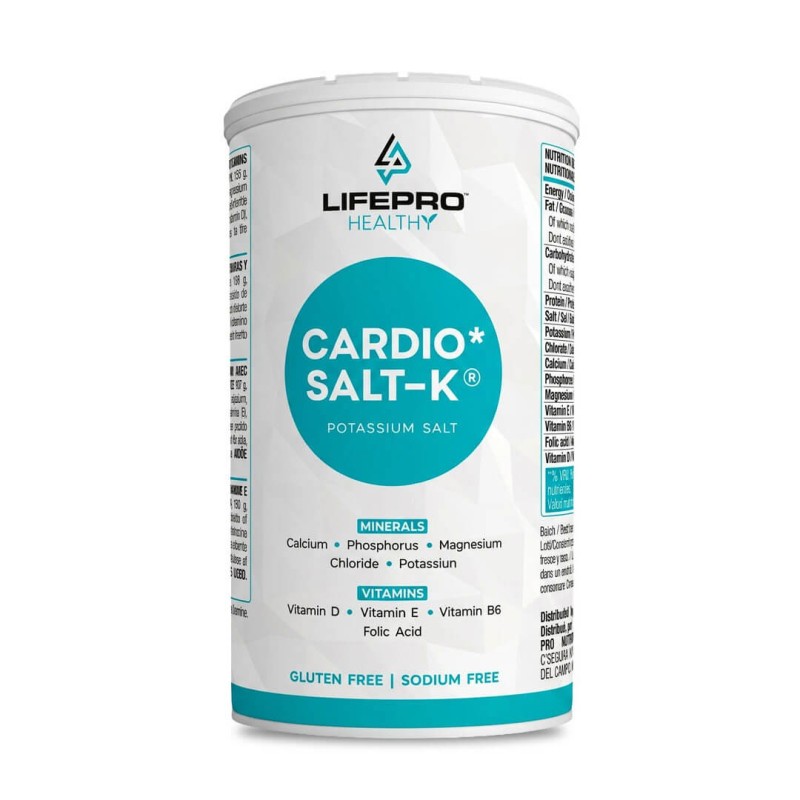
LIFE PRO CARDIO SALT-K 150G
A new way to season your dishes while taking care of your arterial health. Cardio Salt-K is an alternative to regular salt, containing 97.3% potassium chloride and 0 g of sodium. It provides 1,021–1,532 mg of potassium per day, a mineral that contributes to the maintenance of normal blood pressure.
97,3% potassium chloride51-77% NRV of potassiumVitamins and minerals
6.27 €
5.64 €
WITH COUPON
9157
✓Up to 1,532 mg of potassium with 3 g✓0 grams of sodium✓An alternative to table salt for your meals✓150 g container: 2-3 months of use
The formula

Change the salt shaker
Reduce sodium,
add potassium
Table salt is composed mainly of sodium chloride. Cardio Salt-K takes a different approach, based on 97.3% potassium chloride. An alternative for seasoning your dishes that allows you to replace conventional salt and incorporate potassium into your daily diet, without changing the way you cook. You can make the switch fully or gradually, while adding to your meals a mineral that performs essential functions in the body.
97,3%
Potassium chloride in the formula
51-77%
NRV of potassium with 2-3 g per day
0 g
Sodium per 100 g
Ca · Mg · Vit.
Formula enriched with calcium, magnesium and vitamins
The formula, step by step
We change the mineral, measure the potassium and set the dose
01
Replace
We start with potassium chloride, which provides a salty taste without the sodium chloride found in table salt. It makes up 97.3% of the formula: 0 g of sodium per 100 g.
02
Provide
Each 100 g contains 51,059 mg of potassium. With 2-3 g per day, you get 1,021-1,532 mg, between 51% and 77% of the NRV. Potassium contributes to the normal functioning of muscles and the nervous system.
03
Complement
You can also use it to complement table salt: mix them in whatever proportion you prefer and achieve the best flavour while reducing sodium content without even noticing. In addition, the formula is enriched with calcium, magnesium (bisglycinate) and vitamins E, B6, D and folic acid: an extra that adds value to every serving.

Evidence
Evidence
Why replace sodium with potassium?
Diet plays a fundamental role in maintaining cardiovascular health. In this context, replacing part of conventional salt with potassium-containing alternatives makes it possible to reduce sodium added to meals and incorporate a mineral that contributes to the maintenance of normal blood pressure. This strategy has been investigated in studies such as the SSaSS clinical trial, which assessed partial replacement of table salt in people with a history of stroke or over 60 years of age with hypertension. The formula studied contained 25% potassium chloride, compared with 97.3% in Cardio Salt-K.
How its ingredients are studied
Meta-analysisOverall view
Systematic review
Randomized trial
Observational
Opinion
What explains the effect
≥75%
Percentage of the reduction in blood pressure in SSaSS attributed to potassium, according to models. Hoorn et al., Nat Rev Nephrol, 2026.
Clinical guidelines
> 3.5 g/day
Potassium intake recommended by the ESC 2024, as is the WHO. The AHA 2026 supports increasing potassium, including through enriched salt. McEvoy, 2024.
The overlooked electrolyte
Low potassium
The Western diet provides a lot of sodium and little potassium because food processing reduces it. O'Donnell et al., Eur Heart J, 2023.
Meta-analysis · Pressure
−5.6 mmHg
Mean reduction in systolic blood pressure when replacing salt with potassium salt (−2.9 mmHg diastolic). Greer et al., Hypertension, 2020.
◆ Randomised clinical trialNeal et al., NEJM, 2021
Partial salt substitution · SSaSS trial
20,995
Participants with a history of stroke or ≥60 years of age with hypertension
4.74 years
Mean study follow-up
600
Rural villages in China included
25%
Potassium chloride in the replacement salt studied
Study results: −14% stroke · −13% major cardiovascular events · −12% all-cause mortality · −3.34 mmHg systolic blood pressure · Open-label, cluster-randomised trial · Comparison: 75% NaCl + 25% KCl versus 100% NaCl · DOI: 10.1056/NEJMoa2105675
Beyond the salt shaker
Less sodium on your plate, more potassium in your day
Blood pressure
A daily gesture, measured in milligrams
With 2-3 g per day instead of salt, you get 1,021-1,532 mg of potassium. Potassium contributes to the maintenance of normal blood pressure.
97.3% KCl + vitamins and minerals
Muscles
Potassium on the table, function in the muscle
With 3 g per day, you add 1,532 mg of potassium (77% NRV, nutrient reference value). Potassium contributes to the normal functioning of muscles.
77% NRV of potassium with 3 g
Nervous system
From the plate to the nervous system
Use Cardio Salt-K in your recipes. With 2 g per day, spread across breakfast, lunch and dinner, you already provide 1,021 mg of potassium, which contributes to the normal functioning of the nervous system.
1,021 mg of potassium with 2 g
Cooking
Salt stays in the cupboard
You can replace it completely or mix it with salt in whatever proportion you prefer: the product provides 0 g of sodium per 100 g. Start with a small amount and do not exceed 5 g per day.
0 g of sodium per 100 g
A simple change to the way you season
2-3 g
This is the daily dose we recommend for most people. Changing the way you season your dishes may be easier than you imagine. Cardio Salt-K allows you to replace conventional salt or combine both seasonings during a gradual transition. It provides 1,021-1,532 mg of potassium.
If you want less salt on your plate
You replace sodium chloride with potassium chloride, which makes up 97.3% of the formula, with 0 g of sodium. Potassium contributes to the maintenance of normal blood pressure.
If you train
With 3 g per day, you get 1,532 mg of potassium (77% NRV). Potassium contributes to the normal functioning of muscles and the nervous system. You take it with meals, without capsules or additional servings.
If you are looking for less salt as the years go by
With age, reduced kidney function and medication that retains potassium become more common. Before starting, consult your doctor. If you have kidney disease, do not use it without medical advice.

Nutritional information
How to use it
Dose2-3 g per day
Daily maximum5 g
Time of consumptionWith meals
Potassium with 2-3 g1,021-1,532 mg · 51-77% NRV
Use it instead of table salt or as a complement to it, and distribute the amount between breakfast, lunch and dinner. Start with less than usual and adjust to taste: in larger quantities, a slightly bitter or metallic note may be noticeable.
What it contains
Potassium chloride97.3%
Sodium0 g per 100 g
Potassium51,059 mg per 100 g
Calcium and magnesium (bisglycinate)Yes
Vitamins E, B6, D and folic acidYes
Before you start
If you have kidney disease, diabetes with kidney complications, or take medicines that retain potassium or potassium supplements, consult your doctor beforehand.
Maximum dose
Do not exceed 5 g per day: at this maximum, the intake reaches 2,553 mg of potassium (128% NRV).
Nutrition facts
Evaluation team

Salud cardiovascular
Dr. José Abellán
Médico cardiólogo

PhD en Ciencias de la Actividad Física y del Deporte
Pablo Jiménez
Ciencias del Deporte

PhD en Ciencias de la Actividad Física y del Deporte
Carlos Alix
Ciencias del Deporte
Questions
Frequently asked questions
Your most frequently asked questions
Does it taste the same as regular salt?
Very similar, with some nuances. Potassium chloride, which makes up 97.3% of the formula, provides a salty taste through a different mineral. In larger quantities, a slightly bitter or metallic note may be noticeable, so start with less than usual and adjust to taste within the recommended 2-3 g per day.
Can I use it if I take medication or have kidney problems?
If you have kidney disease, diabetes with kidney complications, or take medicines that retain potassium (ACE inhibitors, ARBs, spironolactone, eplerenone, potassium-sparing diuretics, trimethoprim or chronic NSAIDs) or potassium supplements, consult your doctor beforehand. With 2-3 g, you provide 1,021-1,532 mg of potassium, and excess potassium may be harmful when the body cannot eliminate it properly.
How much should I use per day?
2-3 g per day. Use it instead of table salt or as a complement to it, and distribute the amount between breakfast, lunch and dinner. Do not exceed 5 g per day. At this maximum, the intake reaches 2,553 mg of potassium (128% NRV). The 150 g container lasts 50-75 days at the recommended dose.
Does it really contain no sodium?
Yes: 0 g of sodium per 100 g. The base is potassium chloride, not sodium chloride, so you can use it to replace salt completely or mix it with salt to reduce sodium in whatever proportion you prefer.
I train every day: what does potassium provide?
With 2-3 g, you get 1,021-1,532 mg of potassium, 51-77% of the NRV (nutrient reference value). Potassium contributes to the normal functioning of muscles and the nervous system, and to the maintenance of normal blood pressure. In addition, you incorporate it without capsules or separate servings, simply by seasoning your dishes.
How does Cardio Salt-K differ from table salt?
The main difference lies in its composition. While table salt consists mainly of sodium chloride, Cardio Salt-K uses potassium chloride as its main ingredient, representing 97.3% of its formula. This allows it to be used as an alternative to conventional salt and to incorporate potassium into your meals, a mineral that contributes to the maintenance of normal blood pressure.