

What are amino acids?
Protein is the macronutrient responsible for gaining muscle mass, maintaining it, and repairing the fibers damaged during training. Proteins are made up of small structures, called amino acids.
Amino acids can be described as nitrogen-containing molecules that form proteins and that, depending on whether they can be produced by the body or not, must be obtained through food.
Amino acids circulate freely through the blood until they are required to carry out specific functions. Subsequently, they form chains of amino acids.
How is an amino acid obtained from a whole protein?
Whether through solid food or a protein supplement, when they are digested and broken down to release the amino acids, this occurs due to a digestive enzyme called protease.
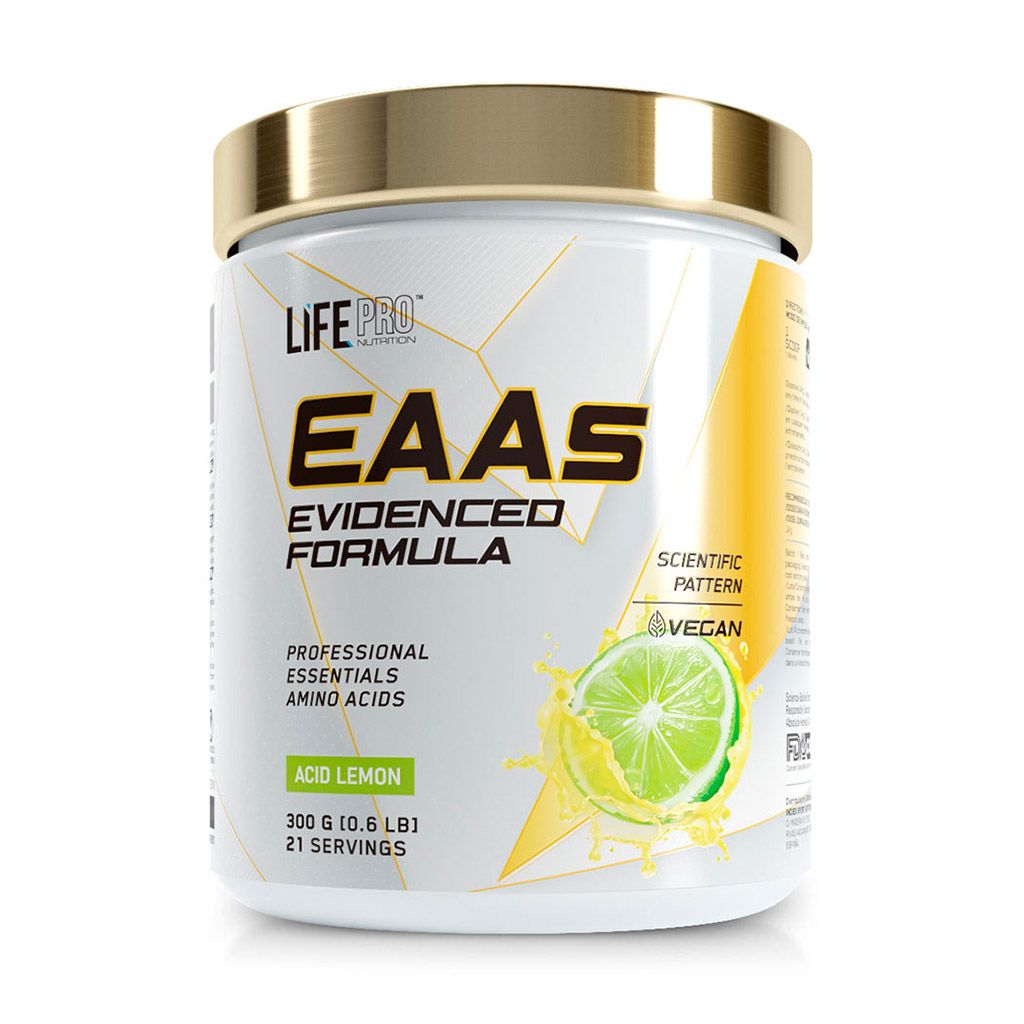 |
LIFE PRO EAAS EVIDENCED FORMULA 300G
Life Pro EAAs Evidenced Formula 300g. Complemento a base de aminoácidos esenciales, con tirosina y cisteína añadidos. Favorece la síntesis de proteínas, optimiza la recuperación y favorece la ganancia de masa muscular. |
25.69€ 28.54€ | Ver producto |
Classification and functions.
The 20 amino acids are classified into 2 large groups.
Essential amino acids.
Essential amino acids are a group that includes 9 amino acids, and they have some distinctive characteristics. They are also called EAAs (essential amino acids).
They cannot be synthesized by the body (or only in very insignificant amounts). They must be obtained through food or supplementation.
When a protein is considered to have high biological value, this is because it contains the 9 essential amino acids in its aminogram.
Leucine:
Together with the following two amino acids (isoleucine and valine), it forms the group of BCAAs, or branched-chain amino acids. Leucine has a close relationship with gaining muscle mass. It can activate the mTor pathway, carry out protein synthesis, and promote the release of growth hormone, which is necessary for muscle growth.
Isoleucine:
Its molecular structure is very similar to that of leucine. It contributes to the formation of muscle tissue, is involved in the formation of hemoglobin, and promotes the entry of different nutrients into cells.
Valine:
It promotes a positive nitrogen balance for gaining muscle mass and protein synthesis, and can be used as energy by the muscle; it promotes the maintenance of muscle mass.
Lysine:
It promotes collagen synthesis and calcium absorption. It is a precursor to L-Carnitine; carnitine promotes the transport of fats to the mitochondria inside cells so that they can be used as an energy substrate.
Phenylalanine:
This amino acid may sound familiar because it is one of the most common components of soft drinks and energy drinks. It can be converted into tyrosine, a precursor to various hormones, such as thyroid hormones. It is involved in regulating appetite and satiety levels because it helps regulate the secretion of cholecystokinin.
Tryptophan:
It is a precursor to melatonin, the substance that is naturally released around bedtime. It also plays a fundamental role in the production of normal levels of GH (growth hormone) and serotonin.
Methionine:
It is a precursor to a non-essential amino acid called taurine (which may also sound familiar because it is a very common ingredient in pre-workouts and energy drinks). It promotes the maintenance of nails and hair, and is a precursor to other compounds such as glutathione, estrogens, etc.
Threonine:
It can be converted into glycogen, and is involved in collagen production and elastin formation.
Histidine:
Histamine is produced from this amino acid. It can also be converted into glutamate. It is abundant in hemoglobin and is important for the production of red and white blood cells.
Non-essential amino acids.
Non-essential amino acids are the remaining group of 11 amino acids. Unlike the previous group, they can be synthesized by the body. Although they can be produced, supplementation with certain non-essential amino acids can sometimes provide multiple benefits.
In this post, we will focus on the previous group: EAAs, or essential amino acids.
What are their benefits?
- They help perform vital functions, such as falling asleep, energy production, and hormone secretion and regulation.
- They promote the creation of the appropriate anabolic environment.
- They prevent muscle mass loss.
- They help postpone the sensation of fatigue.
- They can be used as an energy substrate when required.
- They promote improved performance and contribute to recovery.
Why supplement with EAAs?
EAAs are a convenient and versatile way to consume essential amino acids, which may be suitable for those moments when we want to provide an additional intake, for example, during workouts; they do not need to be digested and do not cause heaviness or stomach discomfort.
When should you take EAAs?
They can be taken:
At any time of day when we want to provide an extra dose of essential amino acids and promote the maintenance and gain of muscle mass.
During training; as they do not cause discomfort and promote the maintenance of muscle mass.
The difference between a complete protein, BCAAs, and EAAs.
Complete protein needs to be digested to release amino acids into the bloodstream; there are fast- and slow-absorbing proteins.
EAAs include the 9 essential amino acids.
BCAAs are a group of 3 essential amino acids: leucine, isoleucine, and valine.