
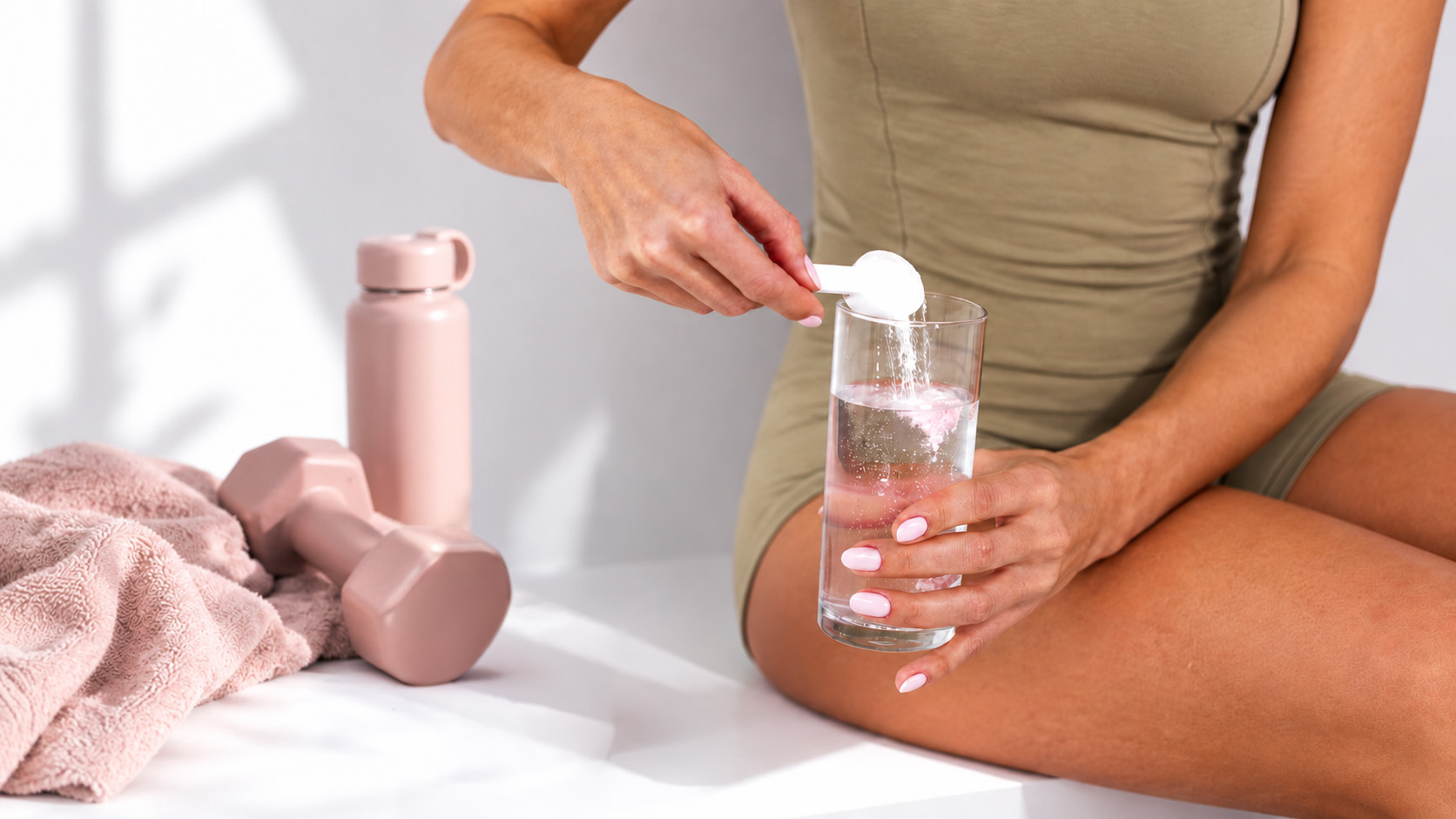
For a long time, creatine was associated almost exclusively with men, gyms, and bodybuilding.
But creatine does not work differently because you are a woman.
The really interesting question is not whether there is a “creatine for women,” but what we know about its use in female populations and which benefits have the strongest scientific support.
And here it is useful to distinguish between two things: what we can state with considerable certainty and those areas that are still being researched.
Performance in high-intensity exercise
This is the strongest area.
Creatine is involved in the energy system used during brief, high-intensity efforts, such as certain sets of strength training, sprints, or repeated efforts.
In women who train, therefore, creatine can be part of a supplementation strategy focused on performance.
But there is an important nuance:
creatine complements training. It does not replace it.
Creatine and strength training in women
A significant part of the research conducted specifically in women studies creatine in combination with strength training.
This is especially interesting because for decades, much of the research on sports supplementation was conducted primarily with men.
Today we have more studies that include female populations and different stages of life.
This allows us to understand increasingly well how the female body responds to supplementation, although there are still areas where we need more specific research.
Particular interest as the years go by
One of the areas receiving the most attention is the use of creatine in adult and postmenopausal women.
Because with age, preserving physical capacity, strength training, and maintaining an active lifestyle become increasingly important.
There are studies investigating the combination of creatine + strength training in these populations.
It is a particularly interesting area, but it is important to avoid turning specific research findings into general promises about bones, menopause, or aging.
You do not need a “creatine for women”
This is probably one of the most important messages.
There is no type of creatine that works exclusively in the female body.
The criteria for choosing a good creatine are essentially the same:
- type of creatine;
- purity;
- traceability;
- quality control;
- manufacturer transparency.
Therefore, packaging aimed specifically at women does not automatically make the product a creatine better suited to them.
Quality matters more than the label.
Creatine is not a hormone
Another common misconception is that taking creatine can cause hormonal changes or “masculinize” the physique.
Creatine is not a hormone or an anabolic steroid.
It is a compound that our own body synthesizes and that we also obtain in certain amounts through foods such as meat and fish.
Does creatine make a woman look too muscular?
That is not how it works.
Muscle development depends mainly on training stimulus, nutrition, genetics, and other factors.
Taking creatine on its own does not build large amounts of muscle.
Therefore, the fear of becoming “too muscular” simply by starting to take creatine comes from a mistaken idea of how this supplement works.
Does creatine make you gain weight?
Here too, it is useful to distinguish between concepts.
Gaining body weight does not necessarily mean gaining body fat.
Creatine is associated with changes in the water content inside the muscle, especially when starting to use it.
That is why some people may notice small initial variations on the scale.
This does not automatically mean that they have gained fat.
There is more and more specific research on women
For years, many sports recommendations were based on studies conducted predominantly in men.
That is changing.
There is currently growing interest in studying creatine specifically in women and in different physiological situations, including:
- different stages of adulthood;
- the transition to menopause;
- strength training;
- active aging;
- certain situations involving greater energy demands.
But the existence of research on a topic does not automatically mean that we can already speak of a proven benefit.
Promising research and proven benefit are not the same thing.
What about the brain, sleep, or mood?
These are areas currently generating enormous interest.
They are also a good example of why research needs to be interpreted carefully.
There are studies investigating the relationship between creatine and different functions beyond muscle, but the level of evidence is not the same as in the sports field.
That is why we prefer not to present them as established benefits of taking creatine.
How much creatine should a woman take?
There is no different dose simply because you are a woman.
A very common reference for creatine monohydrate supplementation is a daily intake of around 3–5 grams.
There is no need to look for especially complex protocols based on sex.
Simplicity and consistency are usually much more important.
Which type of creatine should you choose?
Creatine monohydrate is the form of creatine that accounts for a large proportion of the available research.
When choosing a product, it makes more sense to focus on aspects such as:
purity, quality controls, traceability, and transparency
than on words such as “fitness,” “female,” “beauty,” or “for women” printed on the packaging.
Frequently asked questions about the benefits of creatine in women
What is creatine used for in women?
Its best-established application is related to performance during brief, repeated, high-intensity efforts.
There is also extensive research on its use alongside training, including research specifically involving women.
Does creatine work less effectively in women?
There is no reason to consider creatine an exclusively male supplement.
The energy system in which it participates is present in both men and women.
Do I need to train to take creatine?
Creatine can be used in different contexts, but many of the sports benefits being investigated make sense precisely within a strategy that includes training.
Do I need creatine specifically for women?
No.
Sex does not require the use of a different form of creatine.
Does creatine cause fat gain?
Creatine is not fat and does not automatically imply an increase in body fat.
When starting to use it, weight variations related to muscle water content may occur.
Does creatine alter female hormones?
Creatine is not a hormone.
Therefore, it does not make sense to equate it with hormonal substances or anabolic steroids.
Can I take creatine during pregnancy or breastfeeding?
Pregnancy and breastfeeding require a specific assessment.
In these situations, it is advisable to consult a healthcare professional before starting any supplementation.
So, what are the actual benefits of creatine in women?
The most rigorous answer is also the simplest:
we do not need to invent exclusive benefits for women for creatine to be interesting.
Creatine has been researched in the field of exercise for decades, and we have increasingly more specific information on female populations.
Its interest does not lie in turning it into a new product “for her.”
It lies in better understanding when it makes sense to use it, what it can really contribute, and which claims still need more research.
To wrap up
For years, it seemed that creatine belonged exclusively to the male world.
Science is helping to leave that image behind.
You do not need a special formula because you are a woman.
You do not need a product full of promises.
You need to know what you are taking, why you are taking it, and what evidence supports it.