

If you have ever considered improving your nighttime rest, you have surely come across melatonin. Unlike other hypnotic drugs, this hormone has attracted interest because it acts as a “biological signal” that helps you fall asleep more naturally, without forcing a state of sedation. It is also attributed with antioxidant functions, the ability to modulate the immune response, and involvement in several hormonal processes. However, its most recognized role remains synchronizing the biological clock that regulates periods of activity and rest.
How it regulates our sleep: the role of the light-dark cycle:
Melatonin is produced by the pineal gland, a small organ located deep within the brain. There, the amino acid tryptophan is converted into serotonin and, finally, into melatonin.
This process is clearly influenced by ambient light: at dusk and in dark environments, melatonin production increases to signal to the body that it is time to rest. At dawn, with exposure to light, secretion decreases rapidly, facilitating activation and wakefulness.
The circadian mechanism: a 24-hour clock :
Our body functions according to a daily cycle—known as the circadian rhythm—of approximately 24 hours. This “internal clock” regulates body temperature, hormone secretion, and the sleep-wake pattern. As mentioned above, under normal dark conditions, melatonin secretion reaches its peak around 2 or 3 in the morning, then falls to its lowest level when we perceive daylight.
This pattern explains phenomena such as jet lag. When we fly between distant time zones, our brain continues secreting melatonin according to the previous schedule, and the body takes days to readjust to the new local time. The same happens in workers with rotating or night shifts: their pineal gland receives light signals that are out of sync and does not know whether it should secrete melatonin or inhibit it. Taking exogenous melatonin can serve as a “reset” to align the environment (light and darkness) with the internal biological rhythm.
Immediate-release vs. sustained-release melatonin:
In today’s market, melatonin is available in different formulations, the most common being immediate-release and sustained-release melatonin.
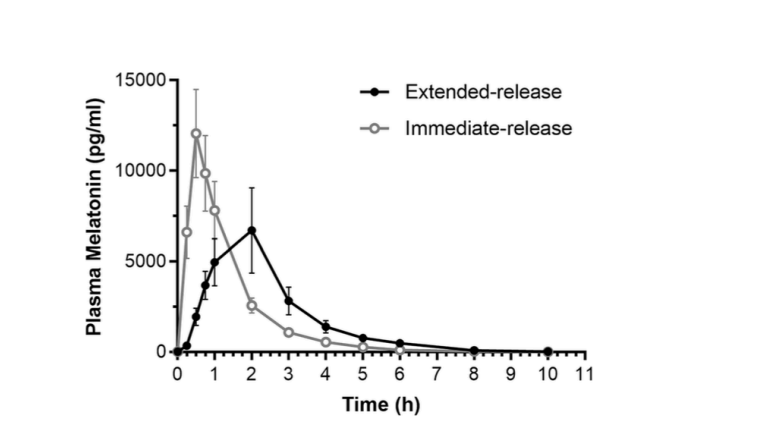
- Immediate release: raises blood melatonin levels shortly after being taken (around 30–60 minutes). It is mainly helpful for people who take a long time to fall asleep, as it mimics the nighttime rise in melatonin. However, its effect usually wears off relatively quickly, since the hormone’s half-life is short.
- Sustained release: also called prolonged release, it aims to mimic the physiological secretion at night by releasing melatonin gradually over several hours. This maintains a more stable and long-lasting concentration, providing support for those who wake up several times or have trouble staying asleep. In addition, studies indicate that its use may be especially valuable in older adults, whose endogenous melatonin production decreases with age. This format provides slower release throughout the night and is associated with a lower likelihood of awakenings occurring during the second half of the sleep cycle.
| Parameter | Immediate release | Prolonged release |
| Time to peak (Tmax) | 0.6–0.75 hours | 1.5–2 hours |
| Half-life (t1⁄2) | 0.5–1 hour | 1.6–2 hours |
| Maximum concentration (Cmax) | 13,120 pg/mL (4 mg) | 7,581 pg/mL (4 mg) |
| Duration of effect | 2–4 hours | 6–8 hours |
| Clinical applications | Sleep induction | Sleep maintenance, circadian rhythm disorders |
Figure 1. Differences between plasma levels of immediate-release versus sustained-release melatonin (Mun, J. et al 2024)
The idea of a hybrid formula arises from the desire to obtain the benefits of the pharmacokinetics of both.
An initial rapid phase that would provide a rapid peak (~0.6 h), ideal for reducing sleep latency in people who have difficulty falling asleep, AND a prolonged sustained phase that would maintain levels >300 pg/mL for 6 h, imitating endogenous nighttime secretion and preventing awakenings.
What else does melatonin do? Beyond sleep
Although its role in sleep regulation is the most recognized, melatonin acts as a multifunctional molecule with implications for multiple systems in the body. Its antioxidant capacity stands out as one of its most valuable attributes: it neutralizes free radicals and reduces oxidative stress, a key mechanism in aging and the development of chronic diseases.
At the cardiovascular level, it protects the vascular endothelium (the inner layer of blood vessels) by combating inflammation and lipid oxidation, factors associated with atherosclerosis and hypertension. Studies suggest that its use could improve arterial function and reduce the risk of
cardiovascular events, especially in people with metabolic disorders or those exposed to chronic oxidative stress.
In the area of fertility, melatonin emerges as an ally for reproductive health. In men, it mitigates oxidative damage to sperm, improving their motility and quality. ÑP In women, it protects oocytes during follicular maturation, which could optimize outcomes in assisted reproduction treatments.
Finally, we cannot forget its action on the central nervous system, with promising neuroprotective effects. By crossing the blood-brain barrier, it protects neurons from oxidative stress and modulates inflammation, a process involved in neurodegenerative diseases such as Alzheimer’s and Parkinson’s.
Conclusion: valuable support for sleep and the circadian rhythm
Ultimately, melatonin has gained recognition thanks to the way it works, which is closer to the natural physiology of sleep than traditional sedatives. Its effectiveness in correcting disruptions such as jet lag, chronic insomnia, or night shifts lies in its ability to readjust the internal biological clock. The two main forms—immediate release and sustained release—adapt to different needs: the former helps you fall asleep more quickly, while the latter helps maintain prolonged rest throughout the night.
That said, however useful melatonin may be, it does not replace good sleep habits or medical supervision in cases of severe insomnia. Adjusting sleep schedules, moderating exposure to bright light at night, and maintaining a healthy lifestyle remain the foundation for good rest. Melatonin, whether in its immediate- or prolonged-release form, provides additional support for those who need to regulate their circadian cycle and optimize sleep quality.
References
- Del Casale, A., Arena, J. F., Giannetti, F., Minervino, A., Biggio, G., & Girardi, P. (2024). The use of prolonged-release melatonin in circadian medicine: a systematic review. Minerva medica, 115(2), 125–142. https://doi.org/10.23736/S0026-4806.24.09303-0
- Mun, J. G., Wang, D., Doerflein Fulk, D. L., Fakhary, M., Gualco, S. J., Grant, R. W., & Mitmesser, S. H. (2024). A Randomized, Double-Blind, Crossover Study to Investigate the Pharmacokinetics of Extended-Release Melatonin Compared to Immediate-Release Melatonin in Healthy Adults. Journal of dietary supplements, 21(2), 182–194. https://doi.org/10.1080/19390211.2023.2206475
- Lemoine, P., Garfinkel, D., Laudon, M., Nir, T., & Zisapel, N. (2011). Prolonged-release melatonin for insomnia – an open-label long-term study of efficacy, safety, and withdrawal. Therapeutics and clinical risk management, 7, 301–311. https://doi.org/10.2147/TCRM.S23036
- Dalton, E. J., Rotondi, D., Levitan, R. D., Kennedy, S. H., & Brown, G. M. (2000). Use of slow release melatonin in treatment-resistant depression. Journal of psychiatry & neuroscience : JPN, 25(1), 48–52.