
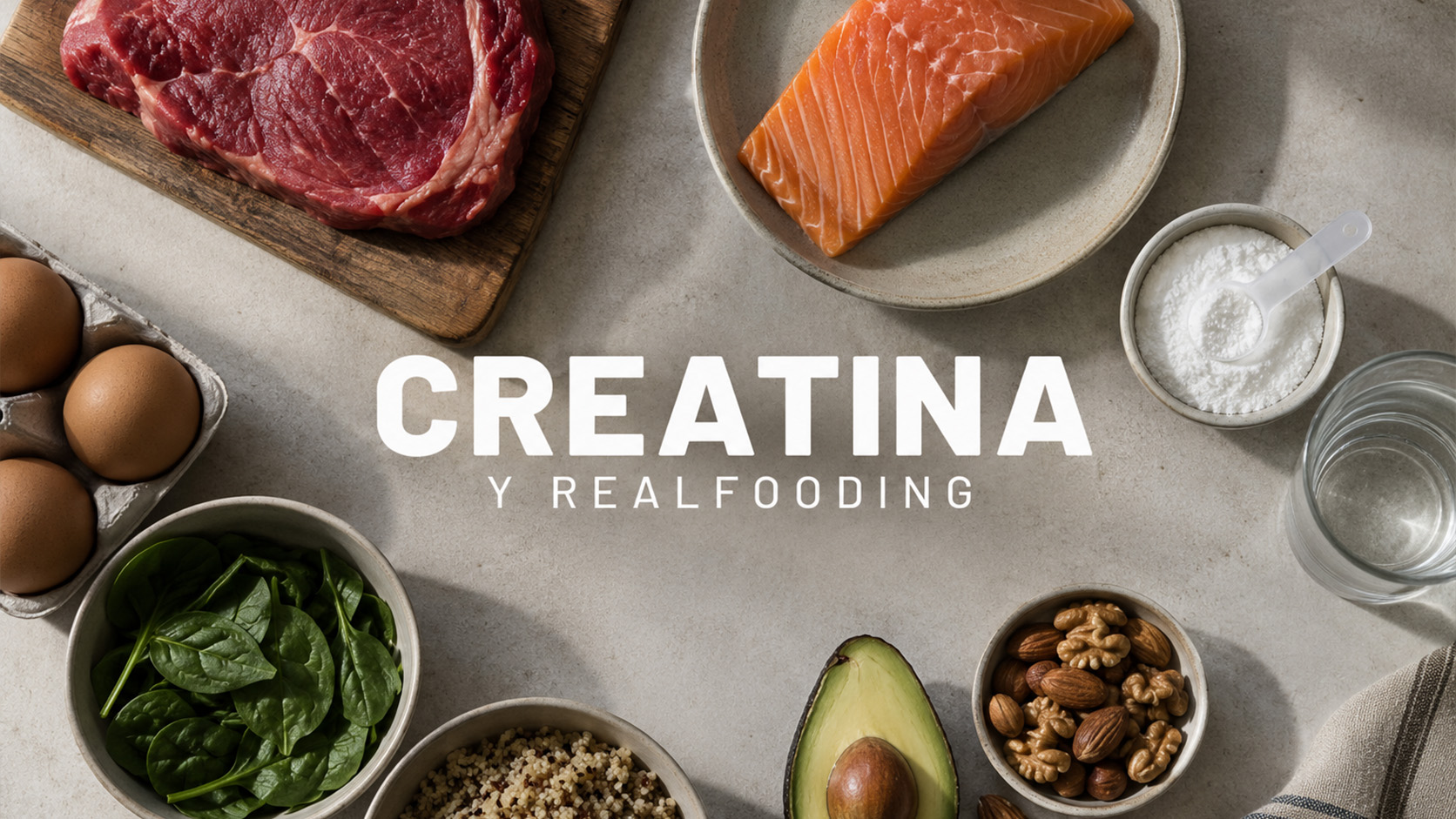
Realfooding focused on something quite simple: understanding better what we eat, reducing unnecessarily complex products, and reading labels more critically.
And when we apply that same logic to supplementation, a fairly reasonable question arises:
does creatine fit into a real-food diet, or is it exactly the type of product we try to avoid?
The short answer is that creatine is not a foreign substance to our bodies. The human body synthesizes it, and it is also naturally present in foods such as meat and fish.
The key is to distinguish between what creatine is and how the product you buy is formulated.
Creatine did not first appear inside a tub
When we talk about creatine, we are not talking about a molecule invented exclusively for the gym.
Our bodies produce creatine naturally, and we can also obtain it through certain foods, especially animal-based foods such as meat and fish.
An important amount is stored in muscle as creatine and phosphocreatine, where it participates in systems related to the rapid availability of energy.
That is why creatine has been studied in sports nutrition for decades.
And here is one of the important ideas for understanding the relationship between creatine and realfooding:
supplementing with creatine does not mean introducing a substance completely foreign to your physiology into your body.
So, is creatine “natural”?
Here, it is worth being precise.
The word natural is used extensively in food and supplementation, but it can mean different things depending on who uses it.
Creatine is naturally present in our bodies and in certain foods.
That does not necessarily mean that the creatine monohydrate in a food supplement is extracted directly from a steak or a fish.
The creatine used in supplements is obtained through controlled industrial processes.
Therefore, instead of simply looking for a label that says “natural creatine”, it is much more useful to ask:
What form of creatine does it contain?
How many ingredients does it have?
Does it contain flavors, sugars, or sweeteners?
Is there information about purity and quality controls?
That tells us much more about the product.
Clean creatine without additives: what does it really mean?
The search for clean creatine without additives makes increasing sense for consumers who want simple formulas.
An unflavored creatine can have an extremely simple composition:
creatine monohydrate.
Nothing else.
If the ingredient list contains only creatine monohydrate, you have a product with a simple composition.
That does not mean that every additional ingredient is automatically negative.
A flavored creatine may contain flavors, acidity regulators, or sweeteners because it needs to deliver a specific consumption experience.
The right question is not:
“Does it have more than one ingredient? Then it is bad.”
Rather:
“Do I want a neutral, simple formula, or would I prefer a flavored version?”
These are different decisions.
Is flavored creatine worse?
Not necessarily.
This is one of those points where a conscious-eating philosophy can become too rigid.
The fact that a product contains flavoring or sweetener does not automatically mean that it is a worse product or that its creatine is less effective.
It is simply a different formulation.
If you are looking for creatine without artificial flavors, sweeteners, or other added ingredients, an unflavored version is usually the simplest option.
If, on the other hand, you know that a flavored version will help you be more consistent, it can also be a perfectly valid choice.
The important thing is to know what you are buying.
What about supplements with no added sugar?
Another common term is supplements with no added sugar.
In an unflavored creatine monohydrate, adding sugar is not necessary for the ingredient to be creatine.
Therefore, if your priority is a simple formulation, you can review the ingredient list and nutrition information.
But it is also important not to confuse two concepts:
“No added sugar” does not automatically mean “better creatine quality.”
Ingredient quality depends on other factors, such as its identity, purity, manufacturing process, controls, and traceability.
The absence of sugar mainly relates to the product’s formulation.
What should you look for when choosing creatine?
If you come from an eating philosophy based on simple ingredients, I would look at five things.
1. The form of creatine
Creatine monohydrate is the form for which there is a vast amount of scientific research.
In addition, the authorized claim in the EU establishes that creatine improves physical performance in successive bursts of short-term, high-intensity exercise, provided that the product supplies a daily intake of 3 g and is intended for adults performing high-intensity exercise.
2. The ingredient list
If you are looking for maximum simplicity, an unflavored creatine with a single ingredient is very easy to interpret:
Creatine monohydrate.
3. Purity and controls
A short list does not tell you everything.
It also matters how the ingredient is manufactured and what controls are in place to verify its quality.
That is why, in addition to looking at how many ingredients appear on the label, it is worth seeking information about analytical controls, traceability, and production standards.
4. Transparency
A good label should allow you to know what you are consuming and in what quantity.
The less a product relies on vague expressions such as “advanced formula,” “ultra premium,” or “proprietary matrix,” the easier it is to evaluate.
5. What you need
If you want maximum simplicity, an unflavored creatine probably makes sense.
If you prefer flavor and know that it will help you consume it more regularly, you can choose a version formulated for that purpose.
The best choice is not always the one with the fewest words on the label.
It is the one you know how to interpret and that fits what you are looking for.
Processed does not automatically mean ultra-processed
Here is another concept that deserves some nuance.
Every supplement undergoes some type of processing.
Creatine monohydrate powder does not appear spontaneously in a container.
It is manufactured, purified, tested, and packaged.
That does not mean we should automatically put every supplement in the same category as all products considered ultra-processed.
The classification of foods according to their degree of processing can be useful for studying dietary patterns, but it does not replace a specific evaluation of each product’s composition and purpose.
With creatine, it is more useful to ask:
What does it contain? Why is it there? What evidence exists regarding that ingredient?
than simply:
“Has it been processed?”
Can you get creatine from food alone?
Yes, we obtain creatine through our diet, especially from meat and fish.
But dietary amounts depend greatly on the type and quantity of food consumed.
Here, I would avoid a statement such as “you would need to eat several kilos of meat a day”, because it depends greatly on the specific food, its creatine content, and the target intake.
The important point is simpler:
the diet provides creatine, but supplementation makes it possible to consume a specific amount of creatine easily and consistently.
In the case of the authorized sports-performance claim in the EU, the beneficial effect is obtained with a daily intake of 3 g of creatine.
Creatine and a vegetarian or plant-based diet
This is one of the most interesting points.
The main dietary sources of creatine are animal-based foods.
That is why different studies have observed that vegetarians have, on average, lower muscle creatine concentrations than omnivores.
A systematic review also found that supplementation increases creatine and phosphocreatine concentrations in vegetarians, although the results regarding whether they respond better than omnivores in terms of performance are not completely consistent.
This makes creatine a particularly interesting ingredient from a scientific perspective when discussing vegetarian diets or diets containing very little meat and fish.
But I would avoid writing:
“If you eat plant-based, you need creatine.”
It is not the same thing.
We can say that their stores tend to be lower; not that every vegetarian needs to supplement.
Is creatine vegan?
Here too, it is worth looking at the specific product.
Creatine monohydrate used in supplementation is usually manufactured through industrial synthesis and does not necessarily come directly from animal tissues.
But the fact that an ingredient may be compatible with a vegan diet does not automatically mean that every commercial product containing it is vegan.
There may be other relevant ingredients, capsules, flavors, or processes.
So, if this is important to you, the safest way to check is to look specifically for the product’s vegan statement or certification.
Realfooding should not mean being afraid of any ingredient that is not in your kitchen
For me, this is one of the most useful ideas in the article.
Reading labels is positive.
Understanding ingredients is positive.
Choosing minimally processed foods as the foundation of your diet can also be a useful strategy.
But turning the ingredient list into:
“if I do not have it in my pantry, it is bad”
can lead to fairly absurd conclusions.
Creatine is a good example.
Its chemical name may sound very “laboratory-like.”
And yet, it is part of human physiology and is naturally present in certain foods.
The interesting question is not whether its name sounds natural.
The question is what it is, what it does, how much we know about it, and what the product you buy actually contains.
Supplementation does not replace a good diet
And here I would draw a very clear line.
The fact that a supplement makes sense in a given context does not turn supplementation into a substitute for a varied and balanced diet.
A food supplement is precisely that:
a supplement.
The foundation remains the overall quality of your diet.
Frequently asked questions about creatine and realfooding
Is creatine an ultra-processed product?
I would not use such a categorical label.
Creatine monohydrate used as a supplement is an ingredient obtained through industrial processing. To assess a specific product, it is more useful to review its composition, form of creatine, purity, controls, and other ingredients than to classify it solely because it has been processed.
Is there clean creatine without additives?
Yes, an unflavored creatine may exist whose ingredient list contains only creatine monohydrate.
Always check the labeling of the specific product.
Does unflavored creatine contain sugar?
Pure creatine monohydrate does not need sugar to provide creatine.
Even so, always review the ingredient list and nutrition information for the product.
Does creatine without artificial flavors work just as well?
The effect of creatine depends on the creatine itself and the corresponding conditions of use, not on whether it has flavor.
Flavors mainly affect the product’s organoleptic characteristics.
Is creatine with a single ingredient better?
If your priority is simplicity, it is the easiest option to interpret.
But having a single ingredient does not by itself prove greater purity or quality.
That is why it is also worth assessing controls, traceability, and manufacturing.
Is creatine suitable for vegetarians?
Creatine monohydrate may be compatible with a vegetarian diet and, in addition, vegetarians generally have lower muscle creatine stores than omnivores.
Always check the composition of the specific product.
Is creatine vegan?
I would not assume so simply because you read “creatine monohydrate.”
Look for the relevant statement or certification for the product you intend to buy.
Does it make sense to combine creatine with a plant-based diet?
It is a scientifically interesting context because vegetarian diets generally provide less dietary creatine, and lower muscle stores have been observed in vegetarians.
That does not mean that everyone following a plant-based diet needs to supplement with it.
To wrap up: a simple label is good; knowing how to interpret it is better
The relationship between creatine and realfooding is much less contradictory than it may seem.
Creatine is not an unknown substance to our bodies: our bodies produce it, and certain foods also provide it.
If you are also looking for clean creatine without additives, an unflavored formulation can be extremely simple: creatine monohydrate as the only ingredient.
But we would not stop there.
A good choice also involves looking at what form of creatine it contains, how it is manufactured, what controls it has, what purity it offers, and what information the brand provides.
Because a short label helps.
A short label and quality you can verify help even more.