
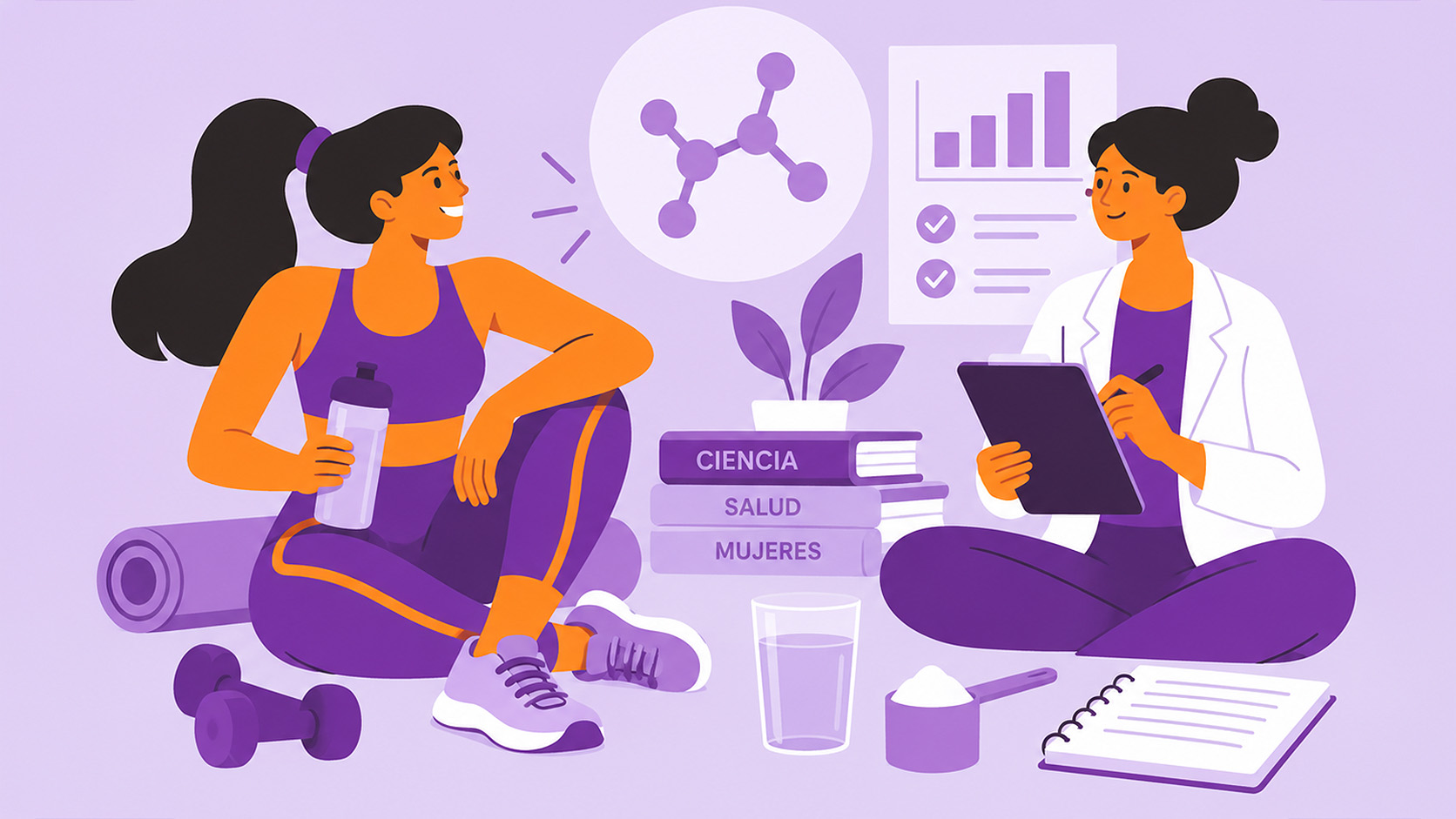
For years, whenever creatine was discussed, the image was almost always the same: young men, the gym, and athletic performance.
But creatine is not a “men’s” supplement.
The female body uses creatine through the same physiological mechanisms and, although historically much less research has been conducted in women, specific evidence is growing.
Today we know that its relevance goes far beyond that old association with bodybuilding.
So, if you have ever wondered whether creatine is right for you, how much you should take, or whether it works differently in women, here is what we know so far.
Why has so little been said about creatine in women?
Not because creatine did not work.
The problem is something else: for decades, much of the research on supplementation and athletic performance was conducted primarily in men.
This has left us with less specific data on certain stages of women’s lives, such as perimenopause, pregnancy, or particular points in the menstrual cycle.
The good news is that this gap is beginning to narrow.
More and more research is focusing specifically on creatine and women’s health, making it possible to answer more precisely questions that until just a few years ago had barely been studied.
Does creatine work the same way in women as in men?
The basic mechanism of action is the same.
Creatine helps increase the availability of phosphocreatine, which is involved in the rapid regeneration of ATP, one of the main energy sources used during high-intensity efforts.
Therefore, there is no “female creatine” with a different mechanism.
What can exist are differences in body composition, diet, initial stores, or hormonal context that influence the individual response.
The important idea: you do not need a pink formula or a special creatine “for women.”
You need a well-formulated creatine.
Benefits of creatine in women
The most well-established evidence continues to relate to physical performance and muscle tissue.
Especially when combined with strength training, creatine has been studied for its role in strength and muscle mass at different stages of life.
In addition, there are currently lines of research in other areas, such as:
- cellular hydration;
- different phases of the menstrual cycle;
- cognitive function;
- aging;
- menopause and the preservation of muscle mass.
Here it is useful to distinguish between what has strong evidence and what is still promising but needs more research.
Does creatine make you look more “bulky”?
This is probably one of the concerns that holds many women back.
Taking creatine does not mean suddenly waking up with a much more muscular physique.
Creatine does not replace the training stimulus.
Nor does it automatically turn an increase in intracellular water into a generally “bloated” appearance.
That is why it is useful to separate two concepts:
muscle size and fluid retention are not exactly the same thing.
How much creatine should a woman take per day?
There is no special dose for being a woman.
The usual protocol used with creatine monohydrate generally falls around:
3–5 g per day
taken consistently.
The amount can be individualized according to factors such as body weight, but there is no general need to use completely different protocols based on sex.
And one of creatine’s practical advantages is precisely this:
there is no need to complicate it.
Consistency matters much more than turning its use into a complicated ritual.
What is the best creatine for women?
Here too, we can simplify things considerably.
The important criteria are the same regardless of sex:
creatine monohydrate, purity, quality control, traceability, and transparent labeling.
You do not need to look for a product specifically labeled “creatine for women.”
In fact, this differentiation usually has much more to do with marketing than with a genuine physiological need.
Is creatine safe for women?
In healthy adults, creatine at usual doses has a widely studied safety profile.
However, there are situations in which it is advisable to consult a healthcare professional beforehand, especially if there is:
- previous kidney or liver disease;
- pregnancy;
- breastfeeding;
- regular medication;
- a relevant medical condition.
There is no need to cause alarm, but neither should we promote the idea that any supplement is suitable for absolutely everyone.
Creatine and the menstrual cycle
This is one of the most interesting areas of recent research.
Possible differences related to cellular hydration and the physiological fluctuations that occur during different phases of the cycle are currently being studied.
But that does not mean you have to stop taking creatine depending on the time of the month.
The general recommendation remains to maintain continuous use.
Creatine, perimenopause, and menopause
This is where we will probably see a great deal of research in the coming years.
During the transition to menopause, hormonal changes occur that are related to body composition, muscle tissue, and bone health.
That is why there is growing interest in studying the role creatine may play during this stage, especially when combined with strength training.
This topic deserves its own development in a specific article about creatine and perimenopause.
Two myths about creatine in women that are best left behind
“Creatine alters your hormones”
There is not enough evidence to generally claim that creatine “balances” or changes female hormones.
It is an overly simplistic claim.
“You need a special creatine for women”
Nor is that true.
Your body does not need a female version of monohydrate.
It needs a quality product, an appropriate dose, and consistency.
Frequently asked questions about creatine in women
Does creatine make you gain weight?
Creatine does not increase body fat by itself.
It can produce changes related to intracellular water content and, in some people, initial variations in body weight.
Do you only need to take creatine on the days you train?
No.
The usual strategy is to maintain a consistent daily intake.
Can creatine be taken throughout the menstrual cycle?
In principle, yes. There is no general contraindication based on the phase of the cycle.
Is there a better creatine for women?
Not because of sex.
The criteria should focus on monohydrate, quality, purity, and product transparency.
Can I take creatine during pregnancy or breastfeeding?
This is a situation in which you should consult a healthcare professional beforehand because specific research remains limited.
Do women get fewer benefits than men?
The available evidence does not allow us to claim that creatine has a systematically smaller effect simply because someone is a woman.
Creatine is for women too
For years, creatine has carried an image that has become too narrow.
It is not only for bodybuilders.
It is not only for men.
And you do not need a “female” version.
It is creatine.
And the more specifically it is researched in women, the more sense it makes to leave those labels behind and start talking about it for what really matters:
the evidence, the quality, and the context in which it is used.