
It is common to find references to “99% pure creatine”, 99.9% or similar percentages when comparing different products. But what does that number really mean? Is creatine with a higher percentage necessarily better? And how can consumers verify that this figure is real?
For those who prioritize product quality and traceability, understanding what creatine purity means makes it possible to compare different options using more objective criteria than marketing terms such as “premium,” “ultra-pure” or “maximum absorption.”
In this article, we explain what that percentage represents, what types of controls can support it and what you should look for when comparing different products.
What does “99% purity” mean in creatine monohydrate?
When we talk about creatine monohydrate with a purity of 99% or higher, we are referring to the purity grade of the raw material according to the specifications and analytical methods used.
It is important to distinguish this concept from the product’s composition.
A supplement may be formulated solely with creatine monohydrate as an ingredient while, at the same time, the raw material may have technical specifications establishing certain limits for moisture, creatinine, by-products or other parameters.
Therefore, “100% creatine monohydrate” in the ingredient list and “99% purity” do not describe exactly the same thing.
The first refers to the declared composition of the product. The second relates to the specifications and analytical controls of the raw material.
Does this mean that the remaining 1% consists of impurities?
Not necessarily in such a straightforward way.
Interpreting 99% purity as “99% creatine + 1% hazardous substances” would be incorrect.
The specifications of a raw material may include different parameters, including moisture and certain compounds related to the manufacturing or degradation process.
Therefore, the purity percentage should be interpreted together with the technical data sheet and analytical results, rather than as an isolated figure.
Two raw materials indicating high percentages may have different specifications and controls.
Where can impurities come from?
Creatine monohydrate used in supplements is obtained through controlled manufacturing processes.
As with other raw materials, these processes may result in by-products or residual compounds, whose presence can be analyzed and limited through quality specifications.
The compounds commonly mentioned when discussing creatine manufacturing include dicyandiamide (DCD) and certain derivatives related to the synthesis process.
The presence of other parameters and contaminants, such as certain heavy metals, may also be analyzed in accordance with the applicable controls and requirements.
Therefore, when we talk about quality, it is not only important to reach a certain percentage: it is also important to know what has been analyzed and what limits have been established for each parameter.
And what about creatinine?
Creatinine deserves a separate explanation because it often appears in discussions about purity.
It is a compound related to the degradation of creatine and is also produced naturally in the body.
Therefore, detecting a certain amount of creatinine in a raw material does not automatically mean that the manufacturing process was inadequate.
Once again, the important thing is to check the established specifications and the results obtained in the corresponding quality controls.
Purity, quality and safety do not mean exactly the same thing
These three terms are often used as if they were synonyms, but it is worth distinguishing between them.
Purity refers to the analytical specifications of the raw material.
Quality is a broader concept that may include manufacturing, controls, traceability, consistency between batches, storage or compliance with specifications.
And a product’s safety cannot be determined solely by looking at a purity percentage.
Therefore, a figure such as 99% or 99.9% provides useful information, but it should not be used as the sole criterion for evaluating a supplement.
What does it mean for creatine to have certified purity?
A quality certification or document may provide additional verification of certain characteristics of the product or its raw material.
However, there is an important nuance here: not all certifications verify exactly the same things.
Depending on the certification, issues related to identity, purity, certain substances, manufacturing processes or other parameters may be analyzed.
Therefore, rather than assuming that any seal automatically guarantees a specific level of purity, it is more useful to ask:
- What organization or entity supports the certification?
- What parameters does it analyze?
- What limits does it establish?
- Are batch-specific controls carried out?
- Is documentation supporting those results available for consultation?
The value of a certification depends largely on what it actually certifies.
What is a certificate of analysis or COA?
If you are researching the quality of a creatine product, you have probably come across the acronym COA, which stands for Certificate of Analysis.
This document records the analytical results or specifications corresponding to a raw material or batch and may include different control parameters.
A COA can provide much more specific information than marketing expressions such as “maximum purity,” because it allows you to know what characteristics have been analyzed and what results have been obtained.
For consumers who are particularly interested in traceability, asking whether analytical documentation is available can be a good way to obtain additional information about the product.
Is purer creatine more effective?
Here it is useful to separate the concepts.
The studied effectiveness of creatine is fundamentally related to creatine as a compound and to the protocol used, not to whether the packaging displays a slightly higher commercial percentage.
A small difference between two high purity percentages does not automatically mean that one product will produce better sports results.
Where purity is especially relevant is as a technical criterion for characterizing and controlling the raw material.
Therefore, if you compare two products, you should not simply assume:
higher percentage = greater effectiveness.
The overall specifications, controls and composition must be evaluated.
99%, 99.9% or 99.99%? How much does it really matter?
The more decimal places appear on a package, the easier it is to think that we are necessarily looking at a superior product.
But the difference between 99%, 99.9% and 99.99% should not be analyzed solely from a marketing perspective.
To understand what the figure really represents, you would need to know:
- The method used to determine it.
- The specifications of the raw material.
- What other parameters have been analyzed.
- The limits established for certain compounds.
- The documentation supporting the advertised percentage.
A very high percentage is much more meaningful when it can be demonstrated through analytical controls and traceability.
How can you tell whether creatine is genuinely pure?
The chemical purity of creatine cannot be determined by looking at the powder.
Objective assessment requires analytical methods and technical documentation.
As a consumer, you can look at several elements:
- Whether the manufacturer clearly identifies the type of creatine used.
- Whether it provides information about the purity or specifications of the raw material.
- Whether traceability exists.
- Whether it reports its quality controls.
- Whether batch-specific analyses are available when appropriate.
- Whether it can provide technical documentation or certificates supporting specific claims.
The more verifiable information available, the easier it is to evaluate the product using objective criteria.
Does solubility indicate that creatine is purer?
Not necessarily.
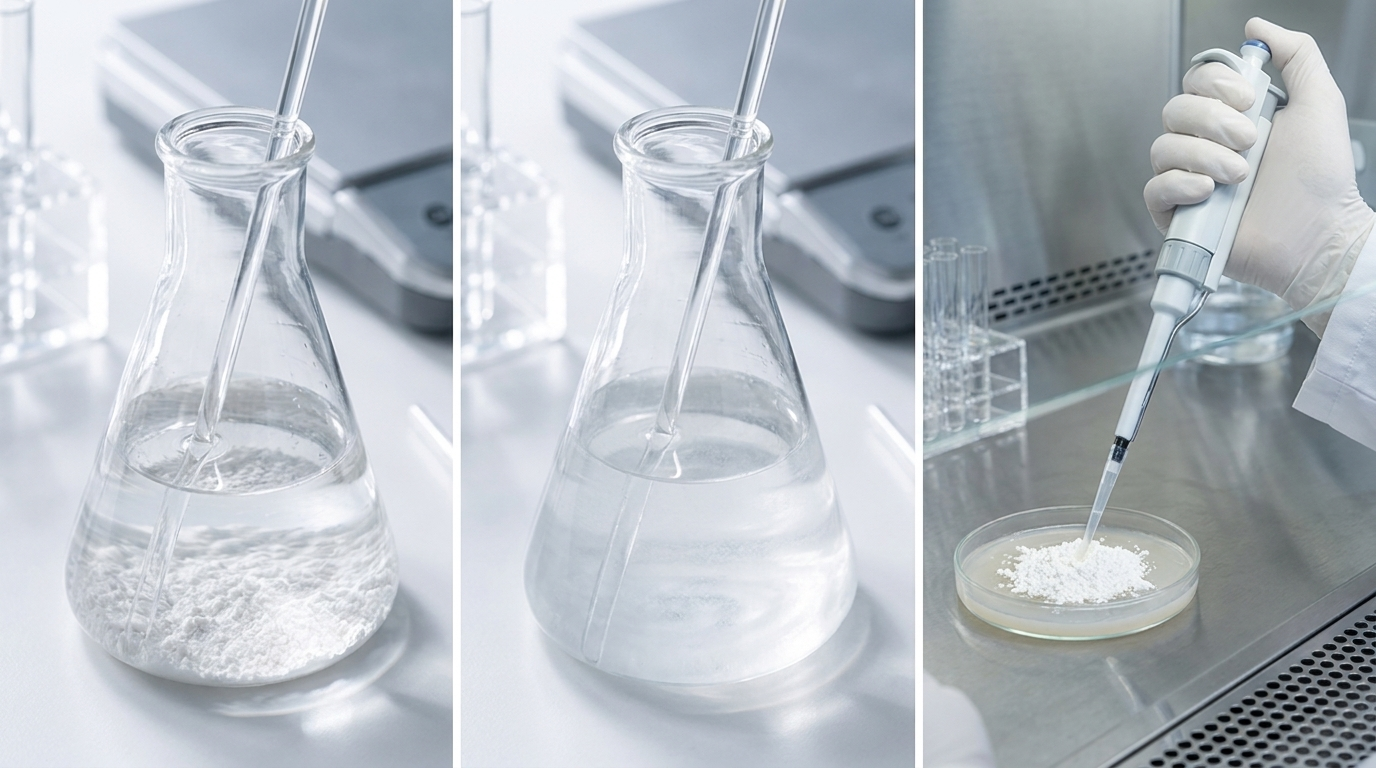
Creatine that leaves some residue at the bottom of the glass is not automatically of lower quality.
Solubility can be affected by factors such as water temperature, the amount of liquid, stirring time or the physical characteristics of the particles.
Therefore, solubility should not be used as a home test for purity.
Analytical controls are needed to determine purity.
And what about the texture of the powder?
Texture alone does not make it possible to determine purity either.
An especially fine texture may be related to particle size or micronization, but this is different from chemical purity.
Creatine may be micronized and have very small particles without this allowing us to visually determine its purity percentage.
What is the difference between micronized creatine and 99% pure creatine?
They are different concepts:
- Micronization: refers to the size of the particles.
- Purity: refers to the chemical and analytical specifications of the raw material.
Micronized creatine may provide certain physical characteristics, such as dispersion, but “micronized” does not automatically mean “purer”.
Likewise, creatine with a high purity percentage does not necessarily have to be micronized.
Can taste indicate purity?
No.
Taste or the absence of taste cannot reliably determine the chemical purity of creatine.
Although certain sensory characteristics may attract the consumer’s attention, they do not replace laboratory analysis.
If you want to verify purity, look for documentation, specifications and controls, not home tests based on taste, color or solubility.
Is it worth paying so much attention to purity?
It depends on what you are looking for as a consumer.
If you simply want to know which creatine is best, purity is one of the criteria you can consider alongside the type of creatine, composition, traceability, manufacturer, controls and price.
For users who are particularly demanding about the origin of raw materials and manufacturing processes, having information about purity and analysis can provide an additional level of transparency.
The important thing is not to turn a single percentage into the sole purchasing criterion.
Questions you can ask any brand
If you want to investigate the quality and traceability of a creatine before buying it, you can ask some fairly simple questions:
- What type of creatine do you use?
- Where does the raw material come from?
- What purity specifications does it have?
- What parameters are analyzed?
- Are batch-specific controls carried out?
- Is a certificate of analysis or COA available?
- Who carries out the analyses?
- What certification supports the product and what exactly does it certify?
A brand capable of providing specific and verifiable information allows consumers to make a much more objective comparison.
Frequently asked questions about creatine purity
Is any creatine with a quality seal automatically 99% pure?
No.
It depends on what that seal actually certifies. Certifications have different objectives and criteria, so it is worth checking which parameters each one evaluates.
A seal should not automatically be interpreted as a guarantee of a specific percentage if that parameter is not part of its specifications.
Is creatine without certification necessarily worse?
Not necessarily.
The absence of a specific certification does not by itself prove that creatine is of lower quality.
A manufacturer may use other control systems, its own or external analyses and technical documentation to verify the characteristics of its raw material.
The important thing is to assess what objective information exists to support the announced specifications.
Does purity affect solubility?
A direct relationship cannot be established simply by observing how the product behaves in a glass.
Purity and solubility are different characteristics.
Solubility depends on different physical factors and should not be used as a method for estimating the purity percentage.
Is creatine that leaves residue in the glass of poor quality?
No.
A small amount of undissolved product does not prove that its purity is lower.
The amount of liquid, temperature and stirring time, among other factors, can modify how the product behaves.
What is the difference between “micronized” and “99% pure”?
Micronization refers to the size of the particles, while purity refers to the analytical characteristics of the raw material.
They are two different concepts, and one does not automatically imply the other.
Does 99.9% mean that the remaining 0.1% consists of contaminants?
Not necessarily.
The percentage must be interpreted taking into account the specifications and the analytical method used. It would be incorrect to assume that everything outside that percentage automatically corresponds to hazardous substances or contaminants.
Is there any regulation requiring the exact purity to be declared on the label?
The mandatory information for a food supplement is regulated, but the exact chemical purity percentage of the raw material should not be confused with the ingredient list or the declared quantity of the product.
Therefore, this information may be found in technical documentation, manufacturer specifications or certifications without necessarily appearing as a prominent percentage on the front of the package.
To wrap up
Talking about 99% pure creatine can provide relevant information about the specifications of a raw material, but the percentage should not be analyzed in isolation.
If you really want to assess the quality of a creatine, also look at which parameters are analyzed, what controls are carried out, the traceability of the raw material and what documentation supports the advertised figures.
The difference is not simply in finding the number closest to 100%, but in being able to verify what that number means and how it has been confirmed.
If you are comparing different products and want to extend your analysis beyond purity, consult our guide on which creatine is best and which criteria really matter.